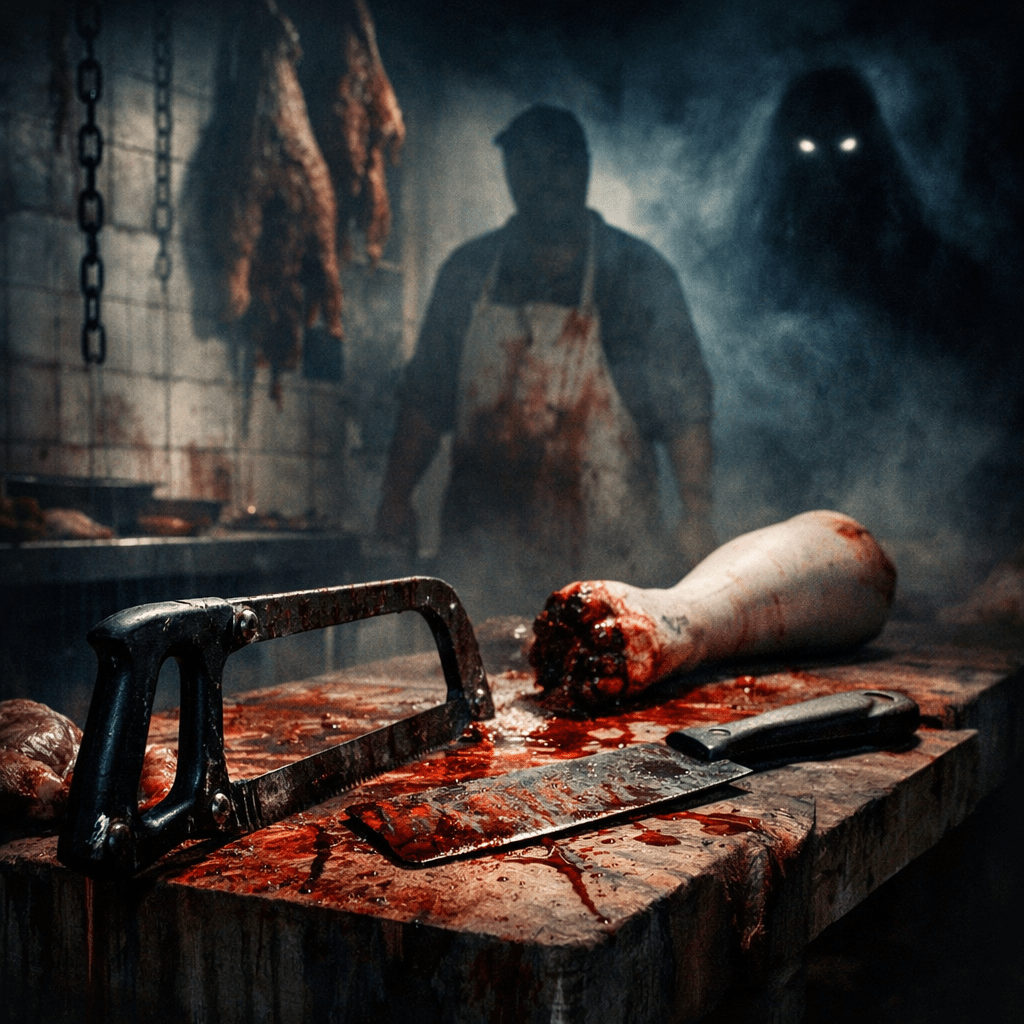
How “The Divider,” an Ancient Shadow of Possession, May Have Manifested in a Modern Crime
Some crimes are so extreme they feel detached from ordinary human motive. They do not resemble anger or impulse, but ceremony. Preparation replaces panic. Tools replace fists. And violence takes on meaning.
In a recent and deeply disturbing case, a man identified in reports as John Martin amputated his wife’s leg in the back of a supermarket he owned and operated. This was not a momentary loss of control. It was an act that echoed punishment, ownership, and ritual.
Reports suggest authorities were alerted after a customer noticed something deeply wrong with a package in the meat section of the store being sold as meat, leading to an emergency call and the immediate shutdown of the supermarket. What remains is a darker question worth examining: what kind of influence allows a human being to believe such an act is justified?
For centuries, cultures have described entities that do not force violence—but feed on possession, jealousy, and control, slowly reshaping a person’s moral boundaries until atrocity feels necessary.
The Entity Known as the “Divider”
In obscure European and Middle Eastern folklore, there exists a recurring figure sometimes called the Divider—an entity believed to emerge in spaces where flesh is routinely cut and power over bodies is normalized.
Unlike demons of chaos, the Divider does not crave bloodshed for pleasure. It thrives on ownership. It whispers the idea that separation restores order: cut away the “tainted” part, remove the perceived source of shame, reclaim control.
Legends place manifestations of this entity in slaughterhouses, butcher stalls, execution yards, and places where human empathy is slowly dulled by repetition. It does not appear as a physical monster, but as a tightening logic—cold, methodical, and convinced of its own righteousness.
The Divider does not command. It justifies.
A Workplace That Blurs Moral Boundaries
The man at the center of this case reportedly worked in—and controlled—the meat section of a supermarket. Day after day, flesh was reduced to product. Limbs became inventory. Separation became routine.
For most people, this distinction remains clear: animals are not humans. But folklore warns that for individuals already vulnerable to obsession or possessive thinking, such environments can weaken internal barriers.
In paranormal theory, entities like the Divider require three conditions to manifest influence:
• A setting where cutting flesh is normalized
• A belief that another person is owned
• A perceived betrayal that demands “correction”
When these converge, the entity is said to take hold—not as a voice, but as a framework through which all actions feel inevitable.
Marriage Is Not Dominion
At the heart of this case lies a belief that has haunted humanity for millennia: that marriage grants authority over another person’s body.
This belief is ancient—and dangerous.
Marriage is not bondage. It is not indentured servitude. It is not a transfer of bodily autonomy. Any worldview that treats a spouse as property mirrors the same logic once used to justify mutilation, branding, and execution.
In folklore, the Divider attaches itself to precisely this delusion. It amplifies the idea that punishment restores balance, that the body of another exists to be corrected or claimed.
Modern law exists to sever this thinking completely.
Infidelity Is Not a License for Violence
In times of betrayal—real or imagined—individuals must protect themselves through lawful means: separation, legal counsel, and police involvement when threats or coercion arise.
No personal grievance transforms mutilation into justice.
In paranormal accounts, the Divider thrives when victims are isolated, when outside authority is rejected, and when the perpetrator convinces himself that external law no longer applies.
This is why police intervention is not optional in such cases—it is the final barrier between grievance and ritualized harm.
The Supermarket as a Hidden Ritual Space
That the act occurred in the back of a supermarket is especially unsettling. Public commerce in front. Secrecy behind. Clean aisles masking brutality.
Folklore often places manifestations of possession in liminal spaces—areas that are neither fully public nor fully private. The back room. The locked corridor. The place where rules are suspended.
Such spaces, according to occult theory, allow internal delusions to externalize unchecked.
The True Horror
Whether one believes in literal entities or not, the pattern is unmistakable. Something ancient resurfaced—not a creature with horns, but a way of thinking humanity has struggled to bury.
The belief that control equals love.
The belief that punishment equals justice.
The belief that another person’s body can be owned.
These ideas are the real haunting.
A Final Reckoning
This article does not suggest the supernatural absolves responsibility. It does the opposite. Folklore exists to warn us—about what happens when certain beliefs are allowed to survive unchallenged.
If entities like the Divider exist, they do not arrive uninvited. They are built—slowly—through environment, entitlement, and silence.
The only true exorcism is vigilance, law, and the unwavering assertion that no relationship grants the right to mutilate another human being.
When Archaic Justice Reappears
In ancient times, acts of adultery were often met with extreme punishments, including stoning—practices rooted in eras where individual autonomy was secondary to rigid codes of control and honor. Modern society exists precisely to move beyond such brutality. Today, betrayal or infidelity is a matter for personal boundaries, legal separation, or lawful intervention—not violent retribution. When archaic notions of punishment resurface in the present, they do not represent justice or tradition, but a dangerous regression that the law is meant to prevent.
 The ChillX Zone
Leave a comment