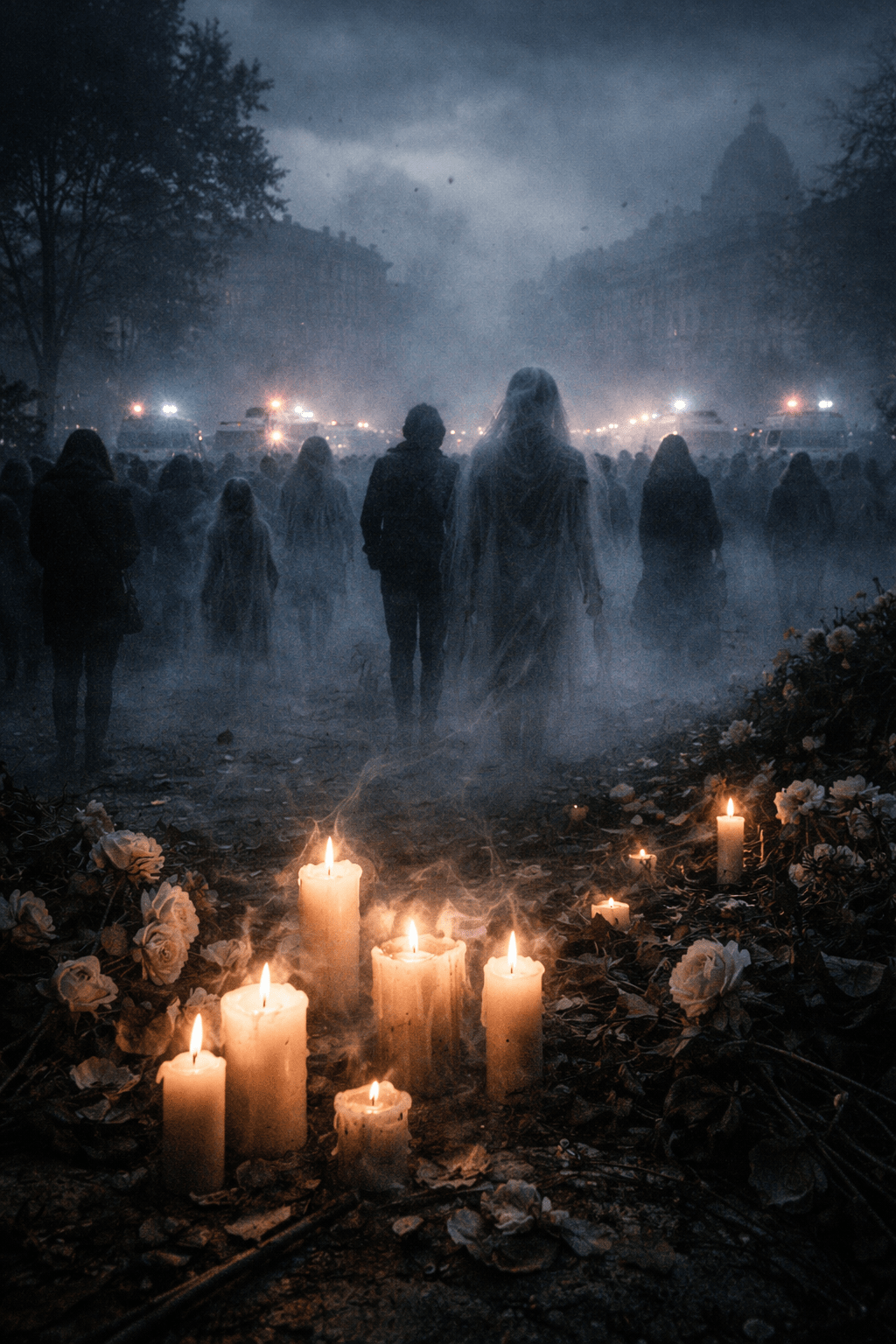
Why global death surges and unexplained societal disturbances are increasing, and why the response has become a humanitarian question
January 18, 2026
History shows a pattern that repeats with unsettling consistency. When death accelerates on a mass scale, reports of paranormal activity rise shortly afterward. This is not folklore drifting in from the margins. It appears in city records, private diaries, newspapers, hospitals, and court testimonies. The phenomenon is not tied to one culture or belief system. It follows loss.
The modern world treats death tolls as statistics. The human nervous system does not.
The Instigation: 1918 and the Silence That Followed
In 1918, as the influenza pandemic swept across the world, tens of millions died in less than two years. Entire families vanished. Cities went quiet. Burial schedules collapsed. Grief outpaced ritual.
Within months, something else surged.
Spiritualist movements exploded across Europe and North America. Not gradually. Suddenly. Séance houses multiplied. Mediums reported unprecedented “traffic.” Ordinary people—teachers, nurses, clerks—documented voices, knocks, apparitions, and persistent presences in homes that had recently lost occupants.
What made this period different was scale. The experiences were not isolated or poetic. They were repetitive, mechanical, and often distressing. People described the same patterns independently: disturbances at night, smells associated with the dead, physical interactions, and a sense that something had not finished transitioning.
The world had produced more death than it knew how to metabolize.
When Loss Overloads the Living World
Paranormal researchers later noted something uncomfortable. The activity wasn’t strongest where belief was strongest. It was strongest where mortality had been densest.
Hospitals. Tenements. Military housing. Boarding schools. Places where death arrived faster than mourning could process.
The implication was not mystical comfort. It was systemic strain.
If consciousness leaves an imprint—psychological, environmental, or otherwise—then mass death creates saturation. The living world becomes crowded with unresolved endings.
The Modern Echo
Today’s world is again seeing accelerated death across multiple regions simultaneously. Pandemics, conflicts, displacement, famine, and environmental collapse overlap rather than occur sequentially. Entire populations experience continuous grief without recovery periods.
Alongside this, reports of unexplained phenomena have increased globally. Not sensational hauntings, but patterns similar to past mass-death periods: persistent disturbances, shared experiences among unrelated witnesses, and events centered around sites of concentrated loss.
This is not about ghosts as entertainment. It is about human systems under pressure.
Why This Becomes a Humanitarian Crisis
When societies are pushed into constant survival mode, unresolved trauma accumulates. People lose the ability to grieve properly. Rituals collapse. Communities fragment. Mental health deteriorates.
Paranormal activity, in this framing, is not an enemy. It is a symptom.
A sign that the living are being overwhelmed by what they cannot process.
Attempts at “population control” framed as solutions—forced displacement, neglect, or containment—do not reduce this pressure. They increase it. They create more abrupt endings, more unacknowledged deaths, more unresolved transitions.
The result is not order. It is saturation.
Collective Responsibility
No nation experiencing mass death exists in isolation anymore. Supply chains, political decisions, climate effects, and economic pressures are global. When one region collapses, the stress reverberates.
If unresolved death contributes to instability—psychological, social, or even anomalous—then the responsibility for addressing it is shared.
Not through erasure.
Not through silence.
Not through control.
But through prevention, care, remembrance, and the slowing of loss.
What History Warns Us About
After 1918, the spiritualist surge eventually faded. Not because people stopped believing, but because death rates stabilized. Mourning had time to catch up. Communities rebuilt rituals. Life regained rhythm.
The activity quieted when the living could breathe again.
If today’s world refuses to learn that lesson, the consequences will not be limited to economics or politics. They will surface wherever unresolved loss accumulates.
And history suggests they will not stay quiet forever.
Why Stabilization Becomes Necessary
When deaths begin to outnumber the living, societies lose the ability to absorb loss. Healthcare collapses, burial systems fail, displacement accelerates, and grief goes unprocessed. Under those conditions, instability compounds itself. Humanitarian population controls are not about force or erasure. They are about stabilization—reducing preventable death, slowing displacement, restoring care systems, and giving communities time to recover. Without stabilization, loss does not resolve. It multiplies.
 The ChillX Zone
Leave a comment