When Ordinary Life Slipped Into the Strange — and an Entire City Lost Its Rhythm
December 31, 2025
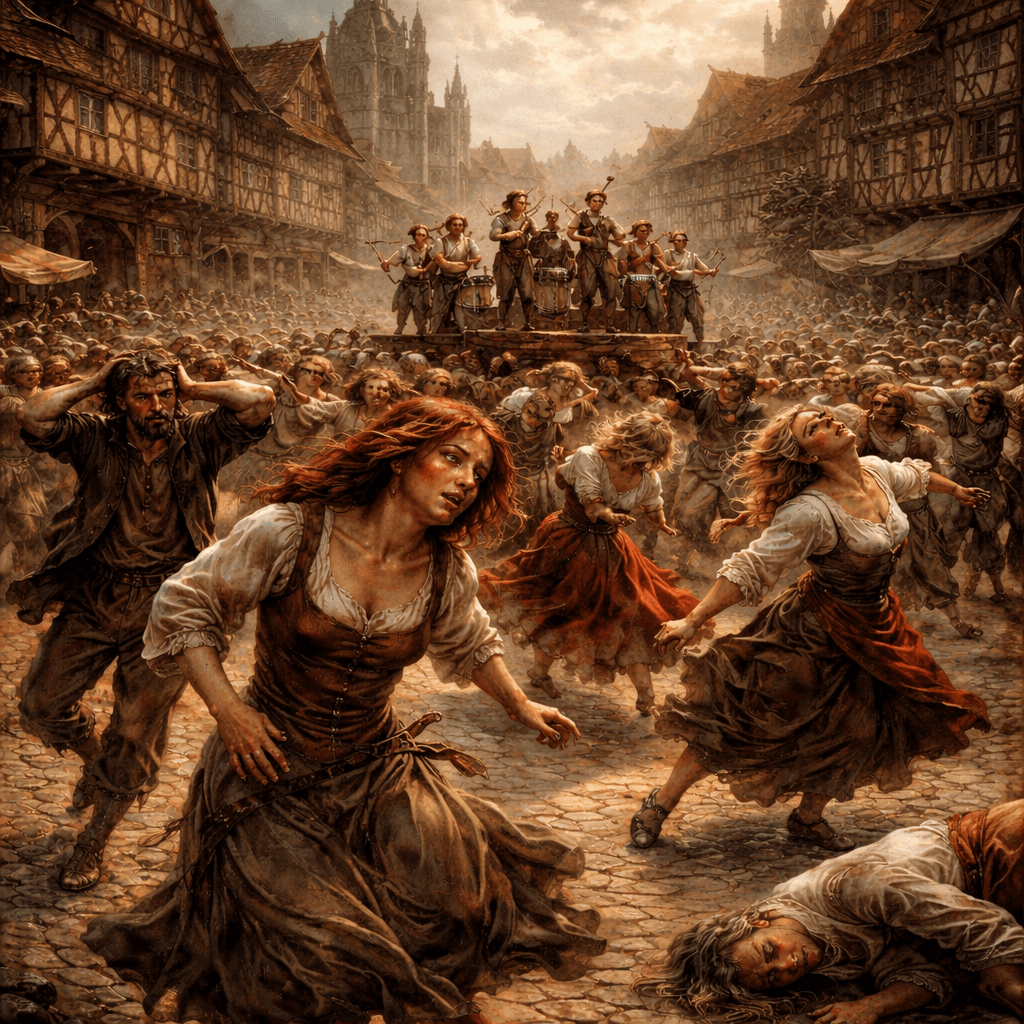
The story of 1518 did not begin like a legend or a myth. It began like any other morning. Strasbourg was already a city under pressure — food shortages, disease, fear, and rumors that God or fate was growing impatient with humanity. Into that atmosphere stepped one woman, Frau Troffea, who walked into the street and started to dance. She did not look entertained. She did not look free. Witnesses later said she moved like someone trying to escape something no one else could see.
People would remember that moment the way we remember the second before a car crash, or the second before something shatters. It was the first slip — the moment when the world twitched out of alignment.
When the Human Mind Starts to Leak
As the days passed, the number grew. Ten dancers. Then fifty. Then hundreds. No celebration. No music. Just bodies moving on their own, like marionettes whose strings were pulled by panic, grief, or something deeper in the human mind. Their feet tore open. Bones ached. Some collapsed in the street and woke up still moving. It stopped being unusual. It became the new normal, and that was the scariest part. A city doesn’t panic when one person loses control — it panics when everyone realizes it could happen to them.
Doctors claimed it was an imbalance of the blood, a fever of the mind. Priests believed fear itself had opened a door. And ordinary people stood there wondering if life could break like a bone — clean, sudden, irreversible.
When Real Life Turns Surreal
The city tried to control it. First with music, thinking the dancers needed to exhaust the strange force. They built a stage. They brought in drums and fiddles. Musicians played while the dancers shook and stumbled and cried, and for a moment the city looked like a festival designed by a nightmare. The music did not help. It spread the movement like a spark jumping from roof to roof.
Then came prayer, isolation, shrines, desperation. The government issued orders. Families dragged loved ones out of the streets. And still the dancing continued. Not because anyone wanted it, but because sometimes the strange is not a choice — it’s a trap.
What This Says About Us
The event eventually burned out, like a candle that had been lit at both ends. People stopped. Life returned to something like normal. But something remained. Not in their bodies — in their memory. They had seen how thin reality could be. They had learned how fast ordinary days can warp into something unbelievable.
And that’s the part that feels familiar now. We don’t dance uncontrollably, but we spiral in other ways. We overthink. We fear patterns that aren’t there. We chase coincidences until they become stories. A single strange moment can turn into a month of unraveling. A single fear can become a habit. A single year can feel like it tilted off its axis.
A Lesson for a Year That Felt Odd
The Dancing Plague of 1518 is real, but it reads like a metaphor for every time our lives feel like they’re slipping. It reminds us that the strangest times in human history didn’t always involve ghosts or demons — sometimes they were just people whose lives got too heavy, until the pressure cracked something inside the world.
It tells us weirdness doesn’t always arrive with a warning. Sometimes it starts with one person in the street, one moment out of place, one thought that won’t stop moving.
And then it spreads.
 The ChillX Zone
Leave a comment