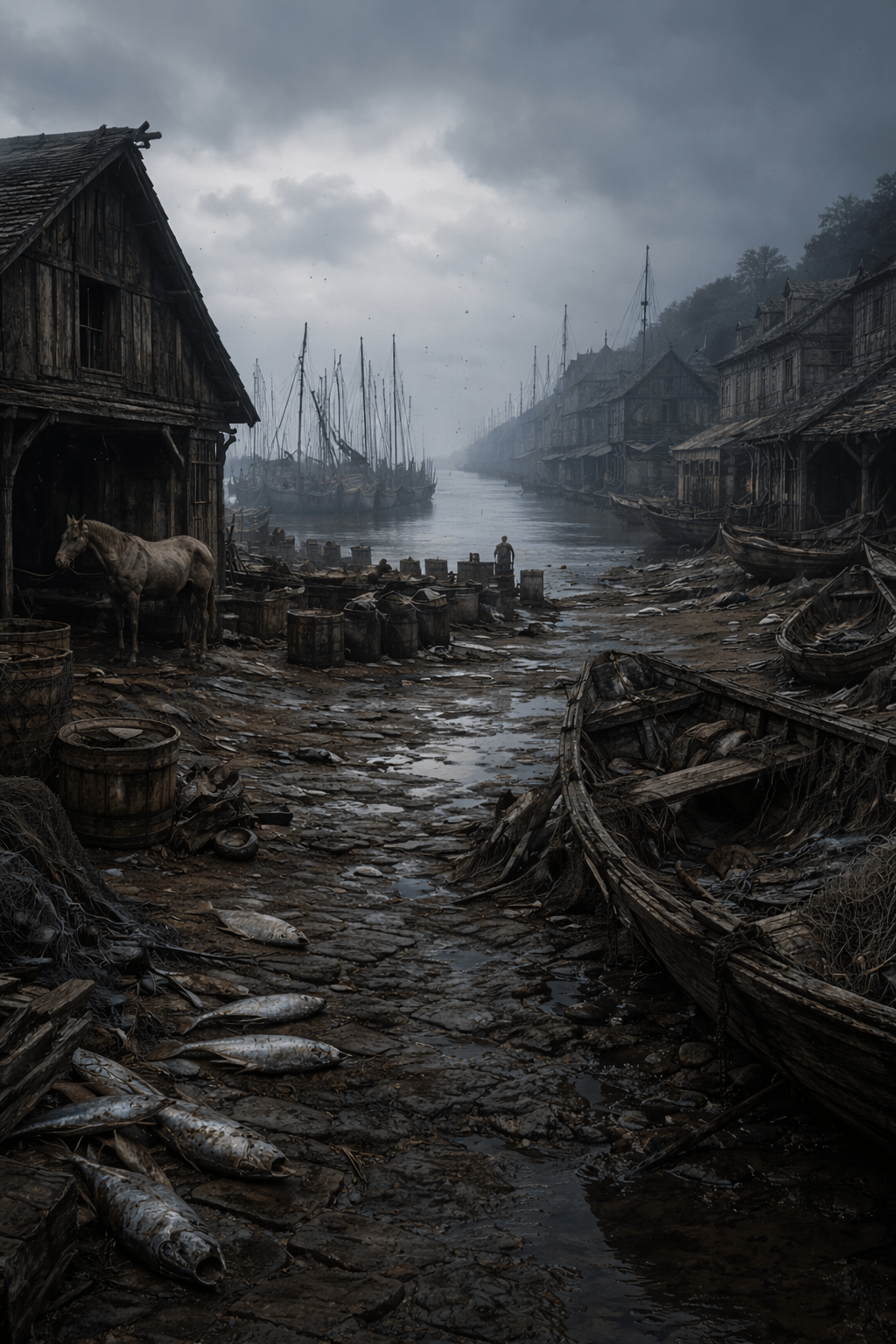
Widespread food shortages, abandoned markets, and unexplained phenomena followed one of the most disruptive environmental events in American history.
December 21, 2025
In the early nineteenth century, Americans along the eastern seaboard believed the ocean would always provide. Fish markets in coastal towns were once loud, crowded places—barrels of cod and herring stacked high, boats unloading before sunrise, money changing hands in the open air.
Then, almost without warning, the markets emptied.
What followed was remembered not just as famine, but as something stranger. A period when food vanished, animals disappeared, and entire industries fell silent at once.
THE YEAR THE SEA STOPPED FEEDING PEOPLE
In 1816, the eastern United States entered what would later be called The Year Without a Summer. Temperatures dropped unexpectedly. Frost struck in June. Snow fell in July. Crops failed across New England and the Mid-Atlantic.
What received less attention at the time was the collapse of coastal fisheries.
Cold waters drove fish populations away from familiar grounds. Harbors that once supported daily trade stood quiet. Markets in Massachusetts, New York, and Maine reported empty stalls. Fishermen went weeks without a viable catch.
Some ports never recovered.
Locals described the docks as “dead,” even at midday.
WHEN STABLES AND FARMS WERE ABANDONED
The famine didn’t stop at crops or fish. Horses—essential for transport and farm labor—became liabilities when feed ran out. Stables emptied as animals were sold, abandoned, or put down. Rural roads that once echoed with hooves went silent.
Travelers wrote of riding for miles without encountering another soul.
Entire farming communities packed up and left, heading west in search of land that hadn’t frozen. Those who stayed behind lived among empty barns and unused fields.
THE STRANGE REPORTS NO ONE KNEW WHAT TO DO WITH
Alongside the shortages came reports that unsettled people in ways hunger alone could not.
Fishermen spoke of hearing voices from fog banks where no boats sailed. Coastal residents described the persistent smell of fish in towns where no fish remained. Some claimed they saw ships offshore that vanished when approached.
Church records from the period include mentions of “unnatural darkness,” sudden temperature drops, and a pervasive sense that the land itself was hostile.
At the time, no one connected these experiences to a distant cause. They were interpreted as omens, warnings, or divine displeasure.
WHY NO ONE UNDERSTOOD IT THEN
The true cause lay thousands of miles away: the eruption of Mount Tambora in 1815, the most powerful volcanic eruption in recorded history. Ash and sulfur entered the atmosphere, altering global climate patterns.
But in early America, there was no way to know that.
What people experienced instead was a slow, eerie unraveling of daily life—food vanishing, animals gone, familiar places hollowed out. The landscape looked the same, but it no longer behaved the same.
WHY THE SILENCE STILL MATTERS
The eastern seaboard eventually recovered. Fisheries returned. Markets reopened. But some towns never regained their former importance. A few became literal ghost towns, abandoned when trade shifted elsewhere.
What lingers is the memory of how quickly abundance turned into absence—and how, during that absence, people reported things that didn’t fit neatly into famine or weather.
Sometimes disaster announces itself loudly.
Other times, it arrives as quiet harbors, empty stables, and the unsettling feeling that something essential has withdrawn from the world.
 The ChillX Zone
Leave a comment