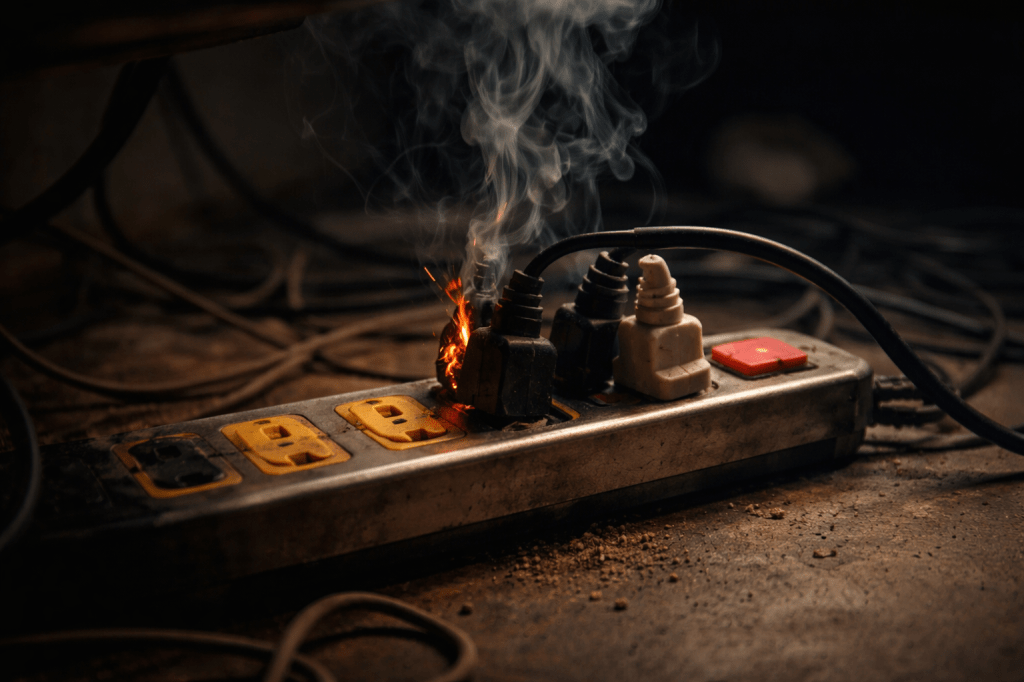
An ordinary household object raises safety concerns after reports of unexplained movement and related injuries.
December 18, 2025
In the old newsroom days, the phrase “may cause serious injury or death” usually meant one thing: somebody somewhere already knew the ending, and the rest of us were just catching up. That warning showed up today not on a chemical drum or a faulty car part, but on something most people don’t even look at twice—a power strip.
The kind that lives under desks. Behind TVs. The silent middleman between your wall and everything you trust with electricity.
WHAT THE RECALL ACTUALLY SAYS
This one had a name. ANNQUAN. Two models. Metal-bodied strips with rows of outlets, sold online for the price of a decent dinner. One black with yellow sockets. One yellow with black sockets. Twelve plugs on one. Six on the other. Switches that clicked with confidence. They promised order. Control. Safety.
They didn’t have it.
The issue is simple and uncomfortable: the strips lack proper overcurrent protection. When too much electricity flows through them, they don’t reliably stop it. Instead of cutting power cleanly, they can overheat. And when metal overheats behind drywall, carpet, and forgotten furniture, fire doesn’t knock before it enters.
WHEN MACHINES START ACTING STRANGE
Seven incidents have already been reported. In each case, a fuse blew. No injuries. No confirmed fires. Officially, that’s called “no reported harm.” Unofficially, it’s called a warning shot.
Back in the ’90s, we used to say machines had moods. Elevators that stalled on certain floors. Printers that jammed when deadlines were near. Radios that crackled only after midnight. You learn not to laugh at those stories when you’ve spent enough nights alone in a building full of humming equipment.
THE MOMENT PEOPLE STARTED NOTICING
People who owned these strips noticed things before the recall landed. Switches that felt warmer than they should. A faint smell that didn’t belong to dust or plastic. A room going quiet all at once when the fuse blew, like something exhaled and decided not to breathe back in.
Electricity is invisible, but it isn’t subtle. When it goes wrong, it leaves signs. Heat where there shouldn’t be heat. Silence where there should be noise. Darkness that feels intentional.
WHY THE WARNING MATTERS NOW
The strips were sold for nearly two years. Thousands of them. Offices. Bedrooms. Workshops. Anywhere someone needed “just a few more outlets.” They worked fine—until they didn’t. And that’s the part nobody ever sees coming, because the most dangerous products aren’t the ones that fail loudly. They’re the ones that behave right up until the moment they don’t.
The recall tells owners to stop using them immediately. Unplug them. Get them out of the house. That’s the rational advice, the kind that fits neatly into a press release.
AFTER THE PLUG IS PULLED
But tonight, somewhere, someone is going to crawl under a desk, reach into the warm dust behind a power strip, and hesitate for half a second before pulling the plug. Because for just a moment, it won’t feel like unplugging an object.
It’ll feel like cutting something off.
WHY THIS STORY FEELS FAMILIAR
There’s a reason warnings like this still raise the hair on people’s arms. In the late 1980s, a family in San Pedro, California reported a string of unexplained electrical disturbances in their home: appliances turning on by themselves, outlets warm to the touch hours after being disconnected, lights flickering in a single room and only after midnight. Fire inspectors eventually traced part of it to faulty wiring, but never explained why devices appeared to activate after breakers were shut off, or why heat lingered where no current should have been flowing. Neighbors called it a haunting. Officials called it inconclusive. The family moved out before anyone could say for certain which explanation was worse.
That’s why a recall like this doesn’t just read like paperwork. It reads like a reminder. Some dangers announce themselves with flames and sirens. Others wait quietly, plugged in, doing their job—until the day they decide not to.
 The ChillX Zone
Leave a comment