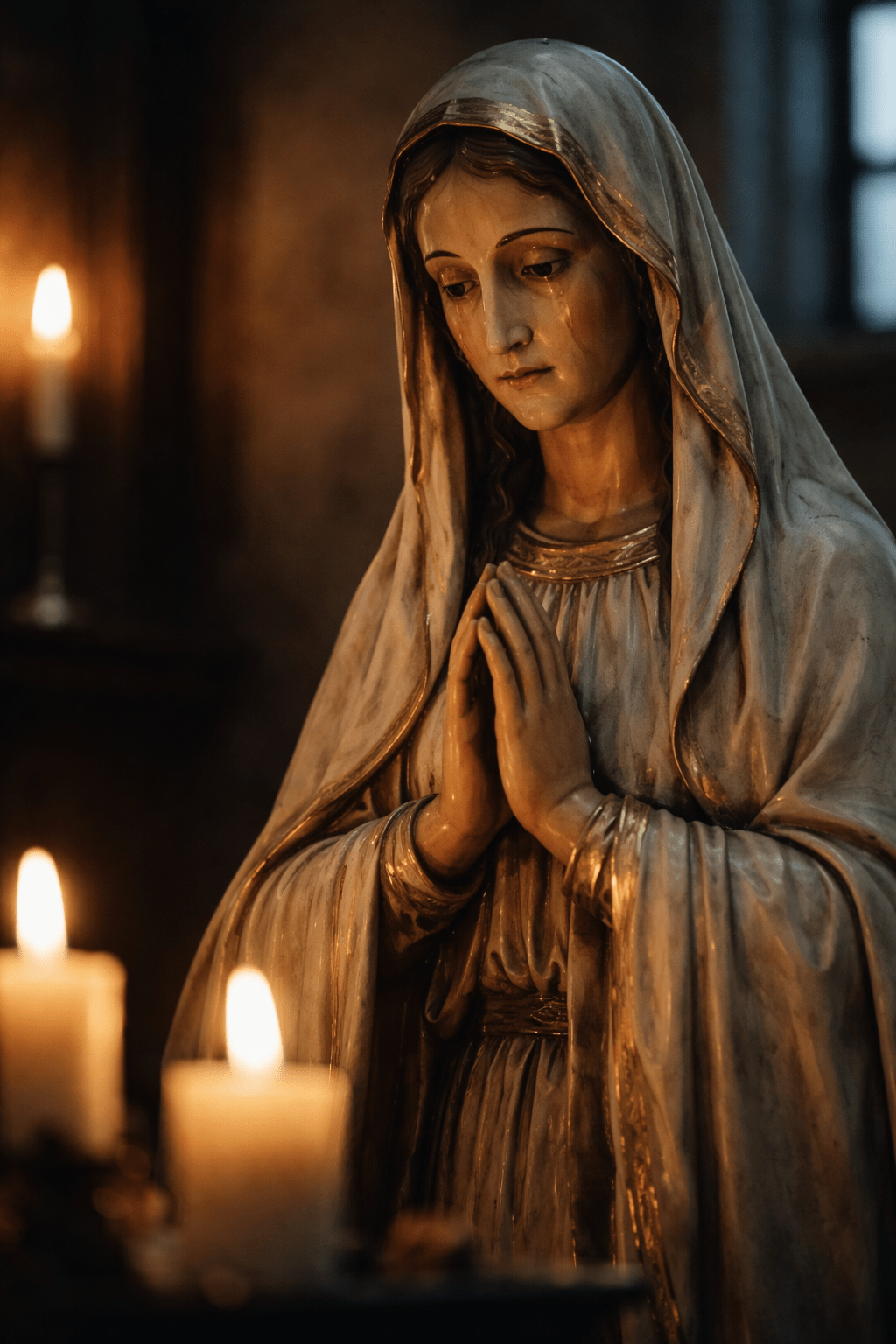
Witnesses reported unexplained movement and injury linked to a religious statue meant to remain still.
December 19, 2025
Statues are created with a single expectation: they remain where they are placed. They do not shift, turn, bleed, or respond. They are meant to be the most predictable objects in a room. That assumption is what makes the events surrounding a small wooden statue in northern Japan so unsettling.
In the early 1970s, a hand-carved statue of the Virgin Mary stood inside a quiet convent in Akita. It was modest in size, plain in appearance, and never intended to attract attention. It was not a relic. It was not ancient. It was simply there, occupying space without demanding it.
Until it began to do more.
WHEN CHANGE WAS FIRST NOTICED
The earliest reports were easy to dismiss. Residents described faint sounds, like wood adjusting under pressure, even when no one was nearby. Others noticed that the statue seemed to be facing a slightly different direction than before. Not fallen. Not disturbed. Just… altered.
At first, no one said anything out loud. Small changes are easier to question than confront. But the reports continued, and they came from different people, at different times, describing the same details.
The statue did not topple. It did not slide. It simply refused to remain exactly as it had been left.
THE INJURY THAT CHANGED EVERYTHING
Concern shifted to alarm when a nun associated with the statue suffered a sudden and severe wound to her hand. There was no clear cause. No accident anyone could point to. Medical examinations offered no definitive explanation.
Shortly afterward, marks were observed on the statue itself, appearing in the same location.
It was no longer just a question of perception. Something physical had occurred, and someone had been hurt.
WHEN STILLNESS WAS NO LONGER THE ISSUE
Reports followed of moisture appearing on the statue’s face, described as tears. Samples were taken. Examinations were conducted. No single explanation satisfied everyone involved. What mattered was not what people believed the cause to be, but that something measurable had happened where nothing should have.
As attention grew, so did risk. Visitors crowded into small spaces. Emotions ran high. People fainted. Others fell. The object itself became a focal point, not just of belief, but of potential harm.
Access was eventually restricted. Not as a judgment, but as a precaution.
WHY THE STATUE WAS REMOVED FROM DAILY LIFE
The statue was never declared dangerous. It was never officially labeled paranormal. It was simply separated from ordinary use, moved out of reach, treated differently than before.
That decision mirrored the way unexplained hazards are often handled: remove the variable, reduce exposure, and hope the pattern stops.
It did.
Once isolated, reports ceased. No further injuries occurred.
WHY THE WARNING STILL MATTERS
The significance of this case isn’t tied to belief. It’s tied to assumption. We assume objects behave according to their materials. We assume wood stays wood, weight stays put, and stillness is permanent.
History suggests otherwise.
Sometimes an object becomes dangerous not because it was designed that way, but because it behaves outside expectations. Sometimes the warning doesn’t come printed on a label. It comes as a pattern people struggle to describe without sounding unreasonable.
And sometimes, the most unsettling thing about an object isn’t that it moved.
It’s that everyone agreed it wasn’t where they left it.
 The ChillX Zone
Leave a comment