A Scientific Examination of the 1957 Phantom Footsteps Case in Northern Maine
December 2, 2025
Fort Kent, Maine — December 4–6, 1957
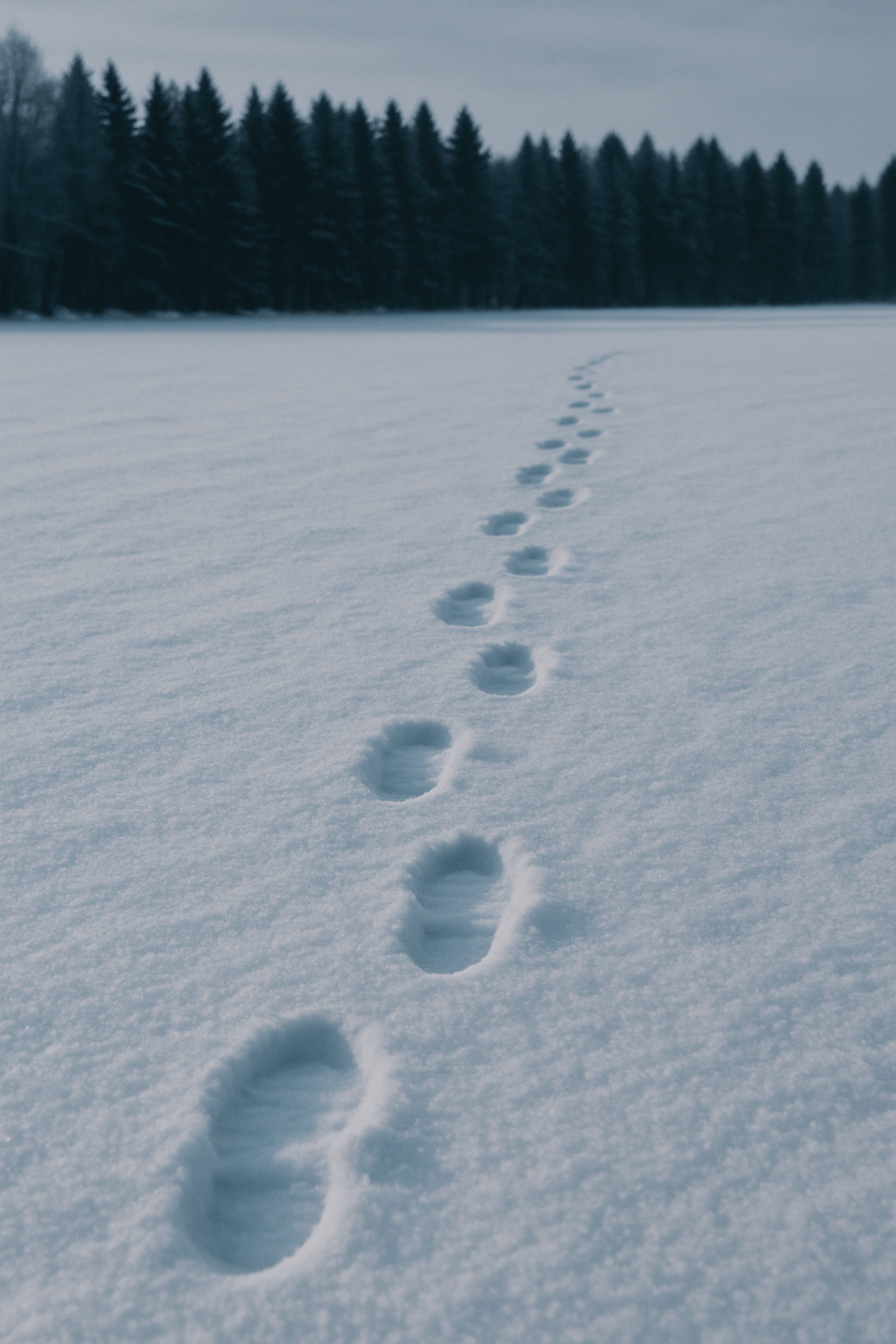
Local residents discovered a series of single-file footprints crossing two miles of fresh, uniform snowfall in a woodland area north of town. The oddity:
The prints began without origin and ended without exit.
- No tracks approached the first print location
- No disturbance in surrounding snow
- The final print stopped abruptly at a frozen river, with no continuation on ice or the opposite bank
A state police memo filed December 6 reads:
“No animal tracks, no drag marks, no attempt at concealment. Pattern is consistent with smooth footwear.”
Physical Conditions at Time of Incident
- Air temperature: 11°F to 18°F over three days
- Snow depth: approximately 6–8 inches of overnight accumulation
- Wind: light, less than 3 mph
- Humidity: low to moderate (cold front stabilization)
These conditions matter because they create an ideal record-keeping surface. Snow of that quality captures footfalls perfectly but does not erase context unless disturbed by wind or melt — neither of which occurred.
If anything, the weather should have made more information visible, not less.
Footprint Characteristics
Investigators documented:
- 132 consecutive impressions
- 9–10 inches in length
- roughly consistent spacing of 28–31 inches between prints
- no visible toe or tread pattern
One unusual detail:
The edges of each print were described as “clean, slightly rounded, not sharply cut.”
This suggests:
- pressure displacement
- not direct carving or pressing
In other words, weight created the imprint — something stepped there.
Eliminated Explanations
❌ Animal Tracks
Moose, deer, and black bear prints were ruled out immediately.
Stride length and shape are inconsistent with quadruped locomotion.
❌ Human Hoax
To fake footprints beginning in the middle of undisturbed snow, a hoaxer would need access from above (tree line or drop). Surveyors found no branches broken and no rope marks on trees.
Additionally, there were no signs of backward-walking or shovel smoothing.
❌ Wind & Snow Disturbance
With wind speeds below 3 mph and stable powder formation, nature would have recorded approach tracks if they existed.
None did.
Cold Weather as a Data Amplifier
One important scientific principle applies:
Cold temperatures preserve surface evidence more reliably than warm conditions.
When snowfall is recent and stable:
- footprints retain depth
- edges remain rounded
- pressure ridges persist
This makes the Fort Kent anomaly not just strange but scientifically valuable, because winter conditions reduced variables rather than increased them.
In environmental forensics, that is rare.
Possible Hypotheses Still Under Review
1. Subsurface Heat Release Pattern
Geologists suggest brief, localized heat plumes can reduce snow adhesion in small areas. But this would produce holes, not lifted impressions with stride spacing.
2. Delayed Pressure Fall
Some snow conditions can retain a footprint shape hours after compression if heat transfer is slow.
However, this can’t explain the lack of origin tracks.
3. Glide Formation
A controversial idea that something could have displaced snow from below along a linear pattern. Requires a hollow corridor or vent, not present in Fort Kent topography.
4. Atmospheric Compression Event
Low-probability event involving pressure waves creating transient snow anomalies — but never documented in repeating steps.
None fully account for the phenomenon.
The Final Observation
A forest ranger on site recorded one detail that never made it into newspaper coverage:
“There was a pause in stride near the river.
We counted three prints closer together, then the pattern ended.”
A pause.
A decision point.
Then nothing.
It implies intent, not accident.
Working Conclusion
The Fort Kent footprints remain one of the most compelling cold-weather anomalies on record because:
- the physical environment eliminated common noise
- documentation was done immediately by law enforcement
- no meteorological or biological explanation fits all facts
Cold weather did not obscure this case.
It revealed it, captured it, and preserved it.
When something stepped out of nowhere…
and back into nowhere.
 The ChillX Zone
Leave a comment