One of Colonial America’s Most Puzzling Aerial Illumination
November 27, 2025
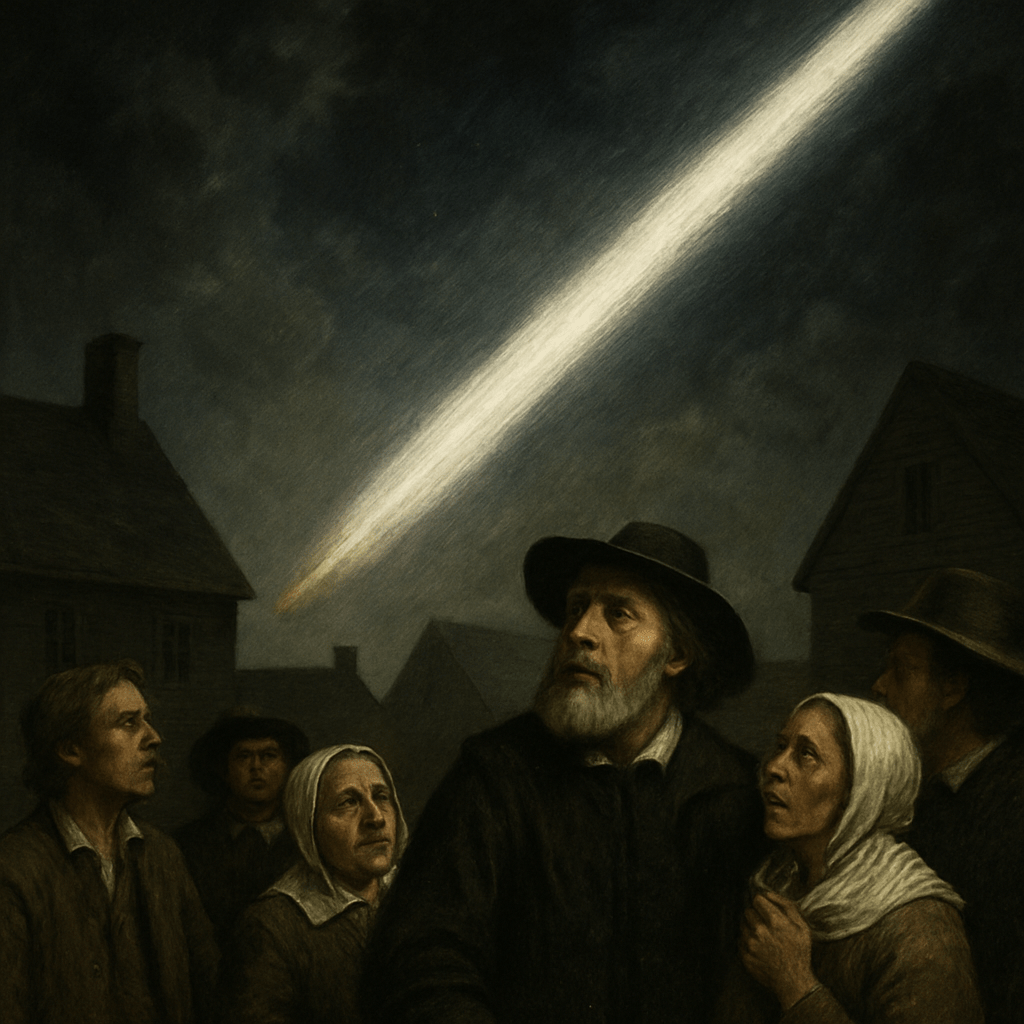
On a frigid March night in 1675, residents of the New Haven Colony reported witnessing what later became known as the Old Ribley Light—a blazing, silently moving beam cutting diagonally across the sky. Although the sighting occurred in March, it was during the November hearings of 1675 that magistrates formally collected sworn testimonies, preserving the incident in the colonial record. The event was chronicled by Puritan minister Increase Mather and several town recorders, who interpreted the spectacle as a sign of divine warning amid King Philip’s War.
The Incident: What Settlers Saw on the Night of March 13, 1675
Although overshadowed by the chaos of war, the 1675 illumination became one of the most discussed unexplained events in the colony’s history.
Witness accounts describe:
- A “straight rod of burning whiteness” appearing suddenly over the harbor
- A motion “slower than a falling star, faster than a drifting cloud”
- No sound, no smoke, and no trail of embers
- A final burst of red light before vanishing near the horizon
One of the most striking reports came from court recorder John Davenport, who wrote:
“The light stood as a blade, firm in the night. No movement of wind nor sound of thunder accompanied it.”
Local magistrates logged 23 separate testimonies—remarkable for an era where such phenomena were often dismissed as superstition.
The Aftermath: Omens and Fear in a Fragile Colony
The incident shook a community already on edge. The colonists were Puritans—deeply religious, hyper-attentive to signs and portents. Within days:
- Farmers refused to work at night
- Ministers held emergency sermons
- The appearance was cited as a “warning of bloodshed” ahead of a devastating year of conflict
This belief wasn’t fringe; the General Court recorded discussions about the light as part of divine providence.
Modern Explanations: Meteor, Comet Fragment… or Unknown Aerial Tech?
Scientists examining the case today suggest:
- An unusually slow, ice-rich bolide (meteor)
- A comet fragment interacting with a temperature inversion
- A rare electro-atmospheric discharge over the harbor
But these don’t explain the most persistent detail in the testimonies: The absolute silence and stationary posture of the beam for nearly two full minutes.
UFO historians have noted the resemblance to modern descriptions of “light walls” or vertical luminous anomalies reported globally in the 20th century.
A Re-Examination in 2025: Why the Old Ribley Light Matters
This month, researchers at Yale University digitized a set of newly rediscovered 17th-century journals from the Davenport family. Among them are two entries not included in earlier transcriptions:
“The light did bend as though it observed us.” (Entry dated March 14, 1675)
“My boy swore he heard humming, though none heard it after.”
These small additions are stirring fresh interest, leading to new conferences and renewed debate within both historical and paranormal communities.
The timing of their release makes November 2025 a fitting moment to revisit this colonial mystery.
Conclusion: A Blade of Light That Never Dims
The Old Ribley Light stands as one of the earliest North American aerial anomalies documented with multiple written testimonies. Whether a misunderstood natural event or a genuine encounter with the unknown, its impact on the colony was profound.
And in the age of satellites, drones, and ever-expanding skies, the 1675 account feels unsettlingly modern.
More than 350 years later, we are still staring into the same dark sky—still asking the same questions.
 The ChillX Zone
Leave a comment