How a Laundry Quarrel, Tormented Children, and Fear of “Hellish Witchcraft” Led to a Hanging
November 15, 2025
A City on Edge Before Salem
Long before the Salem witch trials burned themselves into America’s memory, Boston had already staged its own dark rehearsal. In the autumn of 1688, an Irish Catholic woman known only as Goodwife Ann Glover stood at the center of a gathering storm: a city terrified by children’s fits, a pulpit preaching invisible enemies, and a legal system willing to hang a woman for crimes no one could see.
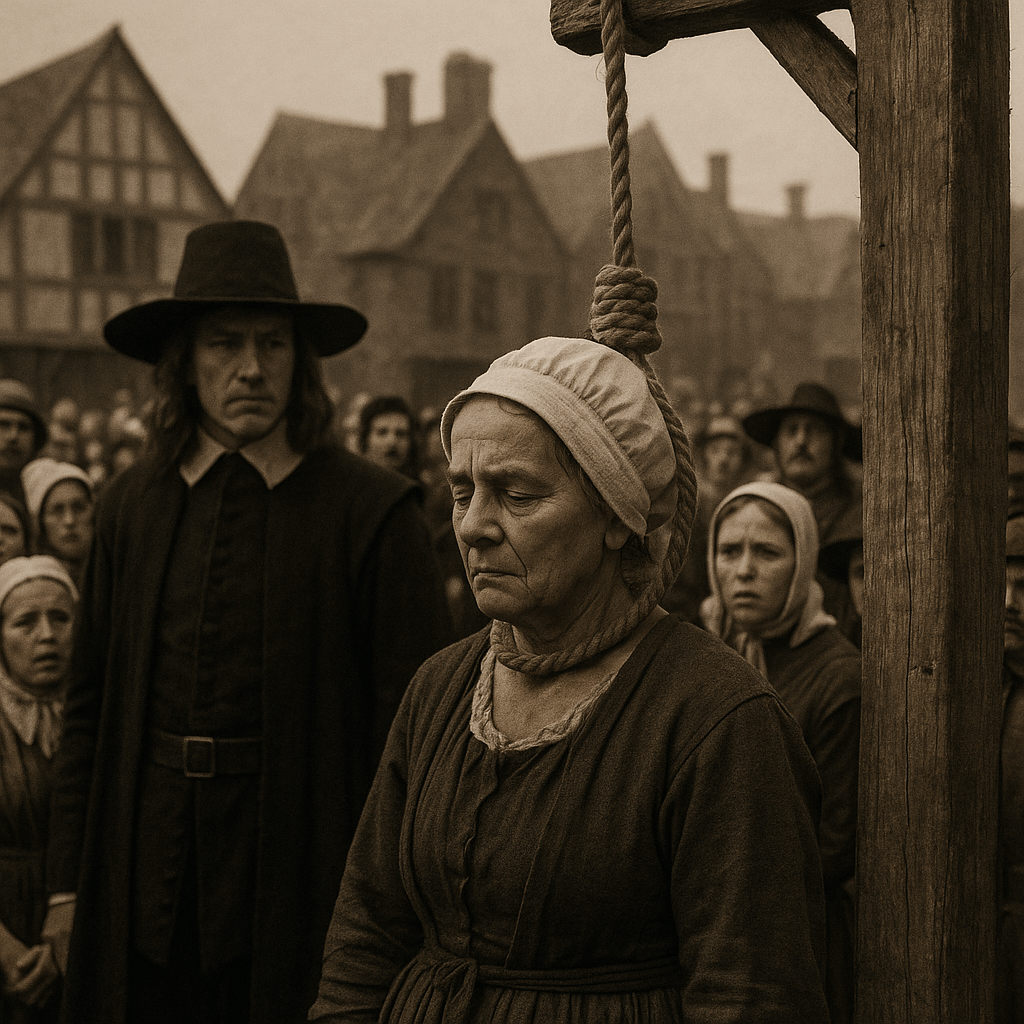
Tomorrow’s date—November 16—marks the day she was hanged on Boston Common for witchcraft, years before Salem’s nooses tightened in 1692.
The Dispute Over Laundry That Unleashed a Panic
It began with something as ordinary as a household argument. Glover and her daughter worked as servants in the home of Boston mason John Goodwin. That summer, a dispute broke out over missing laundry. Harsh words were exchanged. Glover, speaking in her rough Irish and broken English, “bestowed very bad language” on one of the Goodwin children.
Shortly after the quarrel, the children began to change.
Children “Grievously Tormented”
Within days, several of the Goodwin children were wracked by violent, unexplained attacks. Witnesses described them twisting and contorting, their bodies jerking in ways no one could control. They complained of pain everywhere at once—head, eyes, teeth, back, thighs, knees, legs, feet, even their toes.
At times they barked like dogs. Other times they purred like cats. The fits came in waves—sweating, panting, then collapsing in exhaustion. When ministers prayed over them, the convulsions grew more intense, as if the very sound of prayer stirred something that hated it.
A local physician was summoned. Unable to find any physical cause, he blamed what many New Englanders feared most: “hellish witchcraft.”
A Woman Out of Place
Ann Glover was poor, Irish, Catholic, and elderly—everything the Puritan majority distrusted. Years earlier she and her husband had been dragged from Ireland, sold into servitude in Barbados, and eventually brought to New England. By the late 1680s she had lost nearly everything except her daughter, her faith, and her native Irish tongue.
By the time of the accusations, Glover could barely speak English. In court, her heavy Irish and scraps of Latin sounded foreign and unsettling to the judges and ministers listening. When she was urged to recite the Lord’s Prayer in flawless English and failed, many took it as proof of witchcraft instead of language and faith colliding under pressure.
The Nightmares Behind Closed Doors
While the case was building around her, the Goodwin children’s torments escalated. Contemporary accounts describe scenes that, even centuries later, read like something out of a horror file:
They claimed their limbs were being twisted by invisible hands.
They cried out that nails or spikes pinned their heads and bodies to the floor, unable to lift themselves.
They were seen moving in unnatural ways—arms flapping as if they were birds, toes barely grazing the ground, “flying like geese” around the room.
They mimicked animals, snarling, howling, and purring, and then dropping suddenly silent, as if something had let go all at once.
At moments their afflictions would cease, only to return with renewed violence when certain prayers were spoken or certain names mentioned.
Evidence in the Shadows
Authorities searched Glover’s small living space and found little images—simple figures that might have been crude dolls or religious tokens. In Puritan Boston, where Catholic saints were viewed with suspicion, these objects were quickly recast as tools of sorcery.
When questioned about the spirits she prayed to, Glover described a “host” of beings—almost certainly the saints and holy figures of her Catholic faith. To Protestant ears, that sounded dangerously like a stable of demons. The line between heresy and witchcraft blurred until there was no space left to stand safely.
The Trial That Wasn’t Meant to Save Her
In court, Glover’s language barrier and stubborn faith worked against her. She answered in Irish, laced with fragments of Latin. Interpreters struggled. Ministers pressed her with questions about the devil, spirits, and pacts.
Some reports claim she admitted to dealing with spirits. Others suggest she merely refused to renounce what the court already believed. Either way, the verdict moved in one direction.
She was judged competent, convicted of witchcraft, and sentenced to hang.
“My Death Will Not Relieve Them”
On November 16, 1688, crowds gathered on Boston Common. Glover was led to the gallows, still insisting that putting a rope around her neck would not cure the Goodwin children. She reportedly warned that others had a hand in their suffering, and that the afflictions would continue after her death.
According to later accounts, she went to her death unbroken, clinging to her faith, forgiving those who condemned her, and refusing to name anyone else as a witch.
The Torments Continue
If her execution was meant to quiet the city’s fears, it failed. The Goodwin children did not immediately return to normal. Their outbursts, animal-like behavior, and fits continued, forcing ministers and magistrates to look beyond the woman they had just hanged.
Some began to murmur that perhaps the children were now possessed by something deeper than a neighbor’s curse. Others quietly wondered if fear, prejudice, and religious tension had steered them into killing a woman whose greatest crime was being different.
A Shadow That Reached to Salem
The Glover case didn’t vanish into the past. It lingered in sermons, conversations, and memories. When similar fits and accusations erupted in Salem Village four years later, the pattern was familiar: troubled children, frightened adults, a community ready to see the devil in any outsider.
In many ways, Boston’s witch of 1688 set the stage for Salem’s horror of 1692. The script had already been written—only the names and locations would change.
Looking Back From a Different Century
Today, historical markers remember Ann Glover as more than a “witch.” She is seen as an Irish immigrant, a Catholic woman in a hostile Puritan world, and a victim of a society that confused illness, difference, and fear with evidence of the supernatural.
But the details that people shudder at—the children barking like dogs, purring like cats, twisting in invisible bonds, flapping like geese across the floor—still retain a ghostly power. Whether you see them as proof of the paranormal, mass hysteria, or something in between, they remind us how quickly a frightened community can turn one woman into the embodiment of everything it fears.
On the eve of her execution’s anniversary, Boston’s streets look ordinary. But beneath the traffic and brick and city lights, the memory of a poor Irish “Goodwife” and the children who cried out against her still moves quietly, a warning from the past that refuses to fall completely silent.
 The ChillX Zone
Leave a comment