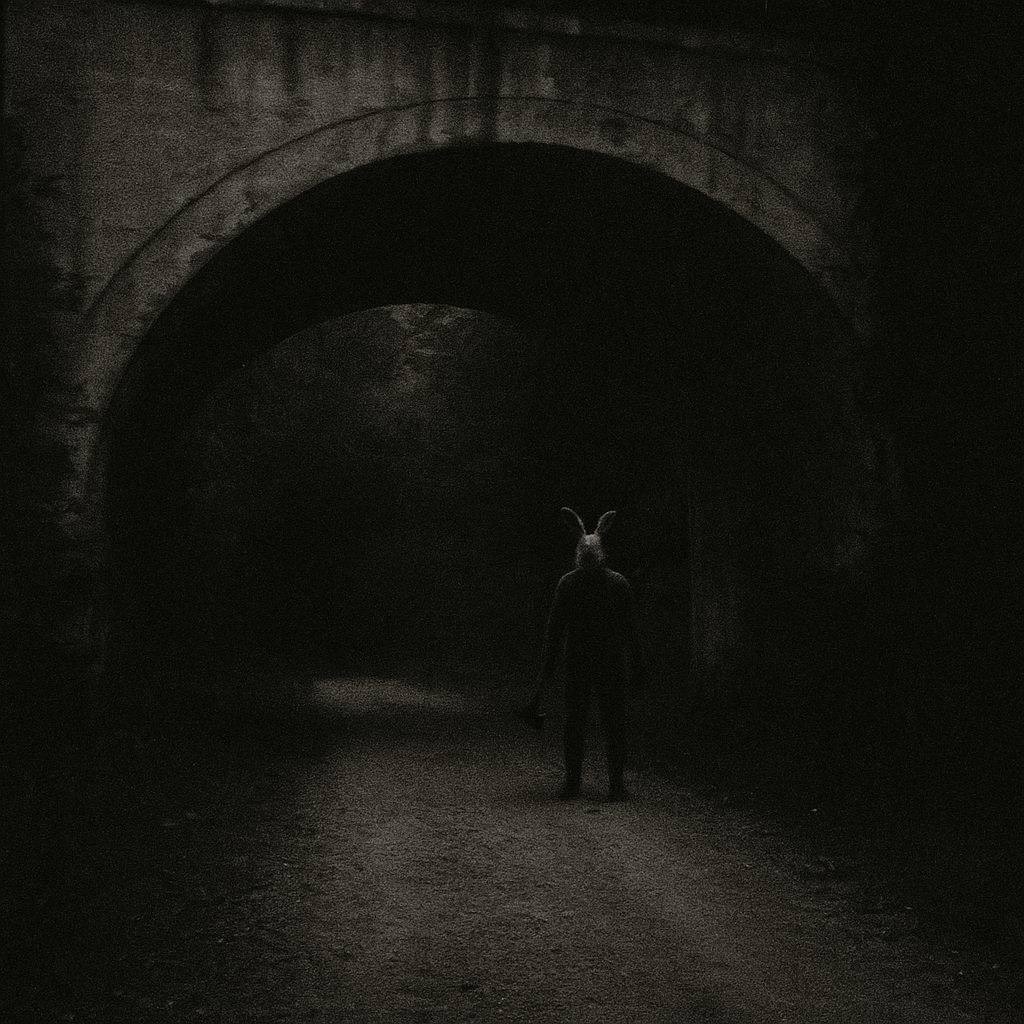
How two hatchet incidents in 1970 spiraled into one of America’s strangest urban legends — and a bridge that still draws ghost hunters every Halloween.
November 6, 2025
The Night the Bunny Came Knocking
Fairfax County, VA — Autumn 1970. In a quiet corner of Clifton, amid the hiss of falling leaves and the hum of distant traffic, a young Air Force cadet and his fiancée pulled over near Guinea Road to talk. What happened next would birth one of the most enduring pieces of American folklore.
Without warning, their car window shattered — a hatchet blade glancing off the glass. A voice from the darkness screamed, “You’re on private property!” The figure they glimpsed wore what the police report later described as a “white or light-colored costume,” possibly with long ears.
The cadet drove off in terror, reporting the attack to local authorities. The story hit local radio the next morning: “Fairfax police seek man in rabbit suit with hatchet.”
From Oddity to Obsession
Ten days later, on October 29, 1970, a night watchman named Paul Phillips spotted a man on the front porch of a newly built home near Kings Park West, chopping at a porch post with a hatchet. When confronted, the intruder again shouted about trespassers and fled into the woods.
Two isolated but bizarre reports — that’s all it took. The media of the day, hungry for anything strange, splashed headlines that practically wrote themselves:
“THE BUNNY MAN STRIKES AGAIN!”
By November, the tale had already metastasized: talk of escaped asylum inmates, slaughtered pets, and a haunted bridge where the “Bunny Man” supposedly hanged his victims.
The Bridge That Became a Shrine
Locals soon attached the story to an isolated rail overpass on Colchester Road — the now-infamous Bunny Man Bridge. Teenagers dared each other to visit it after midnight. Some claimed to hear scratching under the arch. Others swore they saw a figure — half-man, half-rabbit — standing motionless on the tracks.
By the mid-1980s, police patrols increased around Halloween to deter thrill-seekers. Despite countless vigils and paranormal “stakeouts,” no evidence of the phantom ever materialized. Yet the legend grew stronger with every retelling, immortalized in zines, campfire talk, and early Internet message boards.
The Investigator’s Angle
County archivist Brian A. Conley later unearthed the original case files: two documented complaints, both involving a hatchet and threats — nothing more. No murders. No escapee. No asylum.
But Conley admitted something chilling in a 1999 interview:
“I’ve seen hundreds of hoaxes, but none with such staying power. People want this story to be true. It’s as if the Bunny Man became a vessel for their fears.”
In true ’90s investigative style, regional TV stations revisited the case with handheld cameras, green-tinted night vision, and ominous synth music. EMF meters flickered. Audio recorders hissed. And though nothing conclusive was ever caught, the broadcasts gave the old ghost new life.
Symbolism of the Mask
To cultural historians, the Bunny Man is America’s suburban boogeyman — a distortion of innocence turned violent. The bunny, a symbol of playfulness, fused with the hatchet, a tool of destruction. It’s a reflection of a society both fascinated and frightened by what hides behind the picket fence.
The 1990s brought psychological thrillers, slasher films, and suburban paranoia — the perfect soil for such legends to thrive.
The Toll of Time
Half a century later, the bridge still stands. Locals still lock their doors around Halloween, and visitors still leave offerings: broken carrots, toy rabbits, cracked mirrors.
“Every year it’s the same,” said longtime resident Nora Hensley. “You hear that sound — not wind, not trains — just this hollow tapping. And then it stops.”
Whether prankster or phantom, the Bunny Man endures. His tale reminds us that sometimes, fear doesn’t fade — it adapts, waiting for a quiet night, when laughter dies down and the woods go still.
 The ChillX Zone
Leave a comment