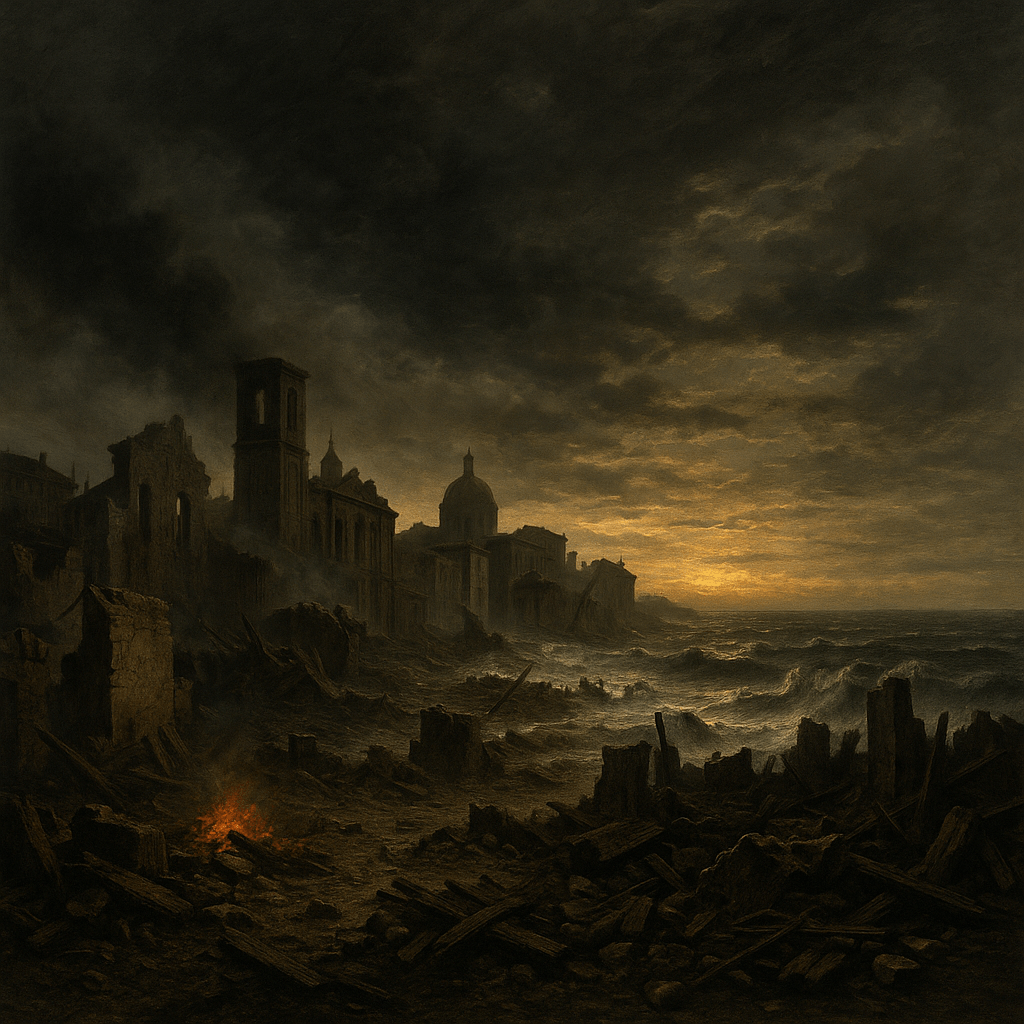
When the Sea Rose on All Saints’ Day
On the morning of November 1, 1755 — All Saints’ Day in Lisbon — the bustling Portuguese capital was shaken by an earth-splitting roar. The massive tremor, later judged one of the most powerful in recorded history, struck around 9:40 a.m., leveling cathedrals, shattering monuments, and igniting fires across the city. Minutes later, the sea itself turned against the coast. The Atlantic withdrew eerily, exposing shipwrecks and seabed, then returned with monstrous force, swallowing the harbor and much of the lower city.
A City of Worship Turned to Ash
It was a holy day. Churches were filled with candles, hymns, and prayer. Within moments, reverence turned to terror as ceilings collapsed and flames erupted from shattered altars. Eyewitnesses described statues toppling, bells ringing wildly on their own, and a “roaring like the voice of the earth itself.” The quake reduced Lisbon’s grand squares to open graves of rubble, and as people fled toward the waterfront seeking safety, the tsunami came roaring in.
A World Shaken in Spirit
To those who survived, it felt as though the divine order had cracked. On a day meant to honor the saints and departed souls, thousands vanished beneath fire, stone, and flood. The event sent shockwaves far beyond Portugal — not just across the continent, but through faith and philosophy alike. Some called it a test from heaven; others whispered that it was a sign that heaven had turned its gaze away.
The Fire That Would Not Die
For nearly a week, the city burned. The night sky glowed orange over the ruins, and witnesses reported strange lights hovering over the Tagus River, misty apparitions that some swore were souls rising from the water. Lisbon, once one of Europe’s proudest capitals, became a spectral landscape — half alive, half dead.
The Age That Followed
From the ashes of that day came change: new architecture, stricter building codes, and an unspoken humility toward nature’s power. Yet even now, on quiet November mornings, locals claim to feel faint tremors, hear echoes of falling stone, or glimpse ghostly silhouettes along the riverbanks at dawn.
Closing Thought
The Lisbon earthquake of November 1, 1755, remains one of history’s great reminders that nature and the supernatural can feel indistinguishable when witnessed through fear. On that All Saints’ Day, the boundary between earth and spirit seemed to rupture — and in its wake, humanity’s faith was forced to rebuild alongside its city.
 The ChillX Zone
Leave a comment