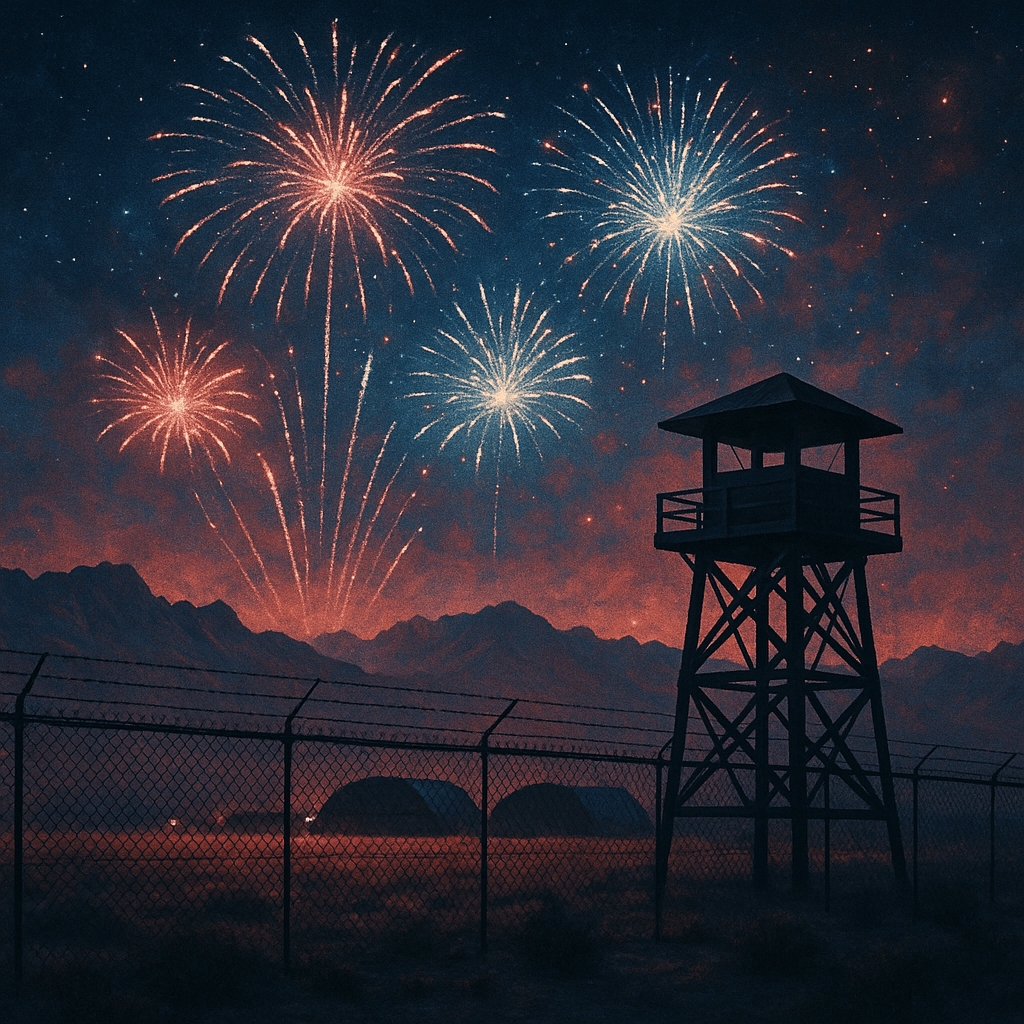
Where Desert Meets Gravity-Defying Crafts
LAS VEGAS, NV (July 4, 2025) — The desert sun beats down on the Nevada Test and Training Range. It casts long shadows over its nondescript perimeter fences. These fences guard one of the nation’s most enduring mysteries: Area 51. In August 2013, the CIA formally acknowledged the base’s existence. They declassified its early U-2 and A-12 programs. Yet, the desert has kept its deepest secrets.
As Americans celebrate Independence Day, few pause to consider the classified airstrip beyond the checkpoints. Its history and whispered secrets have become as much a fixture of desert lore as fireworks.
The Birth of a Classified Enclave
In 1955, Area 51 first entered government records. The Central Intelligence Agency selected the Groom Lake dry lake bed for testing the Lockheed U-2 reconnaissance aircraft. The site was remote and flat. It was surrounded by rugged mountains. This made it ideal for high-altitude experiments beyond the gaze of Soviet satellites and curious journalists.
By the early 1960s, the installation boasted hangars, barracks, and a makeshift runway. Its existence remained an open secret among contractors, but only in 2013 did Washington finally lift the veil.
Independence Day and the Desert’s Vigil
Every July 4, Americans reflect on the freedoms enshrined in the Declaration of Independence. Yet at Groom Lake, freedom takes on a different meaning—national security and technological edge.
While backyard barbecues and fireworks light up city skylines, the dry lake bed stays strictly off-limits. Security patrols intensify, and sirens echo whenever unauthorized aircraft stray too close. For those stationed here, the holiday is marked by extra vigilance—not celebration.
Restricted Access: Lockheed’s Hidden Fortress
Today, Area 51’s boundary remains defined by razor-wire fences, motion sensors, and armed guards. Even seasoned pilots detour hundreds of miles around the aerial “no-fly zone” enforced by the U.S. Air Force. Entry demands top-secret clearance—and a strict need-to-know. Outsiders glimpse only barren desert and an abandoned mining road. Yet inside, cutting-edge engineering unfolds.
Unveiling Anti-Gravity at Area 51: Bob Lazar’s Controversial Claims
In late 1989, Bob Lazar claimed he worked in a facility. He called it S-4, just south of Groom Lake. He said he’d seen nine disc-shaped craft of extraterrestrial origin—each housed in reinforced hangars carved into the ridges.
According to Lazar, these vehicles harnessed stable antimatter to achieve gravity-defying propulsion—far beyond anything publicly admitted by the Pentagon.
The Craft Beyond Our Skies
Lazar’s account ignited both skepticism and intrigue. The government declined to confirm his story. It also declined to deny it. However, the story echoed decades of UFO reports here. Ranchers reported seeing strange lights above Tikaboo Peak. Civilian pilots logged sudden radar disappearances. Hobbyists traced odd flight paths on amateur radio trackers.
Whether fact or folklore, the legend of alien craft at Area 51 has become part of Fourth-of-July lore. It reminds us that some truths may remain forever out of reach.
As Fireworks Fade, the Desert Keeps its Secrets
As the nation sits down to apple pie and fireworks, the hush of the Nevada desert conceals its otherworldly endeavors. On July 4, we commemorate America’s birth. Whether Bob Lazar’s tales hold a kernel of truth is uncertain. They could prove to be an elaborate hoax. One fact remains certain: the secret city in the desert continues to shape our imagination—even as we celebrate independence.
 The ChillX Zone
Leave a comment